Mushroom Farming: Sustainable Agribusiness and Future Career Opportuity
Mushroom Farming: A Sustainable Agribusiness Opportunity in 2025 and Beyond
Introduction
Mushroom farming is emerging as one of the most sustainable, low-investment, and high-return agribusiness models worldwide. With increasing demand for nutritious food, plant-based protein, and eco-friendly farming practices, mushrooms have gained prominence in both rural and urban economies. Rich in proteins, vitamins, antioxidants, and medicinal compounds, mushrooms are no longer limited to gourmet cuisine but are recognized for their health and therapeutic benefits. The ability to cultivate mushrooms using agricultural waste makes this practice environmentally sustainable and economically viable. In India and globally, mushroom farming is being promoted as a solution for food security, entrepreneurship, and employment generation. In 2025 and beyond, mushroom cultivation is expected to play a crucial role in sustainable agriculture, biotechnology, and the nutraceutical industry.
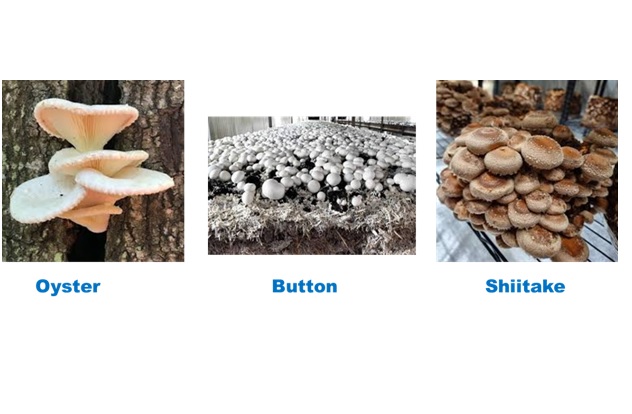
Major cultivated species (Button, Oyster, Shiitake).
What is Mushroom Farming?
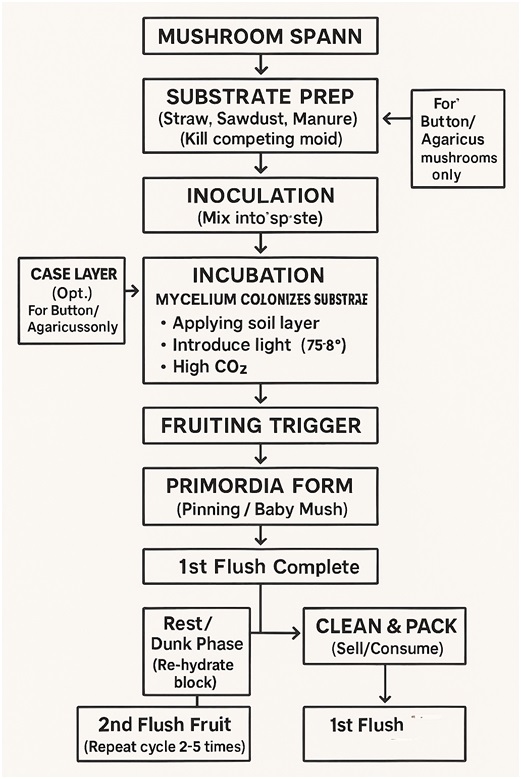
Mushroom farming refers to the scientific cultivation of edible and medicinal fungi under controlled environmental conditions. Unlike green plants, mushrooms do not require sunlight and grow on organic substrates such as straw, sawdust, agricultural residues, or compost. The process involves spawn preparation, substrate sterilization, inoculation, incubation, fruiting, and harvesting. Commonly cultivated mushrooms include Button mushroom (Agaricus bisporus), Oyster mushroom (Pleurotus spp.), Milky mushroom (Calocybe indica), and Shiitake (Lentinula edodes). Mushroom farming integrates principles of microbiology, biotechnology, and environmental science, making it an interdisciplinary field with strong scientific and commercial relevance.
Flow diagram of mushroom cultivation steps from spawn to harvest.
Why Pursue Mushroom Farming in 2025 and Beyond?
Mushroom farming aligns perfectly with global goals of sustainability, nutrition, and entrepreneurship. The sector requires minimal land, low water usage, and offers rapid crop cycles, making it ideal for small-scale and commercial farmers. With rising awareness of healthy diets and medicinal mushrooms, market demand is steadily increasing. Government initiatives, subsidies, and training programs further support this sector. Additionally, mushrooms play a role in waste recycling, converting agro-waste into valuable food products. For students and researchers, mushroom farming offers opportunities in applied biotechnology, food science, and industrial microbiology.
Career Options in Mushroom Farming
- Mushroom Cultivation Entrepreneur
Entrepreneurs establish small- to large-scale mushroom farms for the production of fresh or dried mushrooms. They manage cultivation, harvesting, quality control, and direct marketing to retailers, hotels, and wholesalers.
- Spawn Production Specialist
This role focuses on producing high-quality mushroom spawn under sterile laboratory conditions. Spawn producers play a critical role in ensuring healthy yields and often supply spawn to multiple farms.
- Mushroom Quality Control Analyst
Quality control analysts monitor hygiene, contamination, moisture, and shelf life of mushrooms. They ensure compliance with food safety standards, especially for export-oriented and packaged products.
- Agricultural Extension Officer (Mushroom Specialist)
Extension officers provide technical training and on-field guidance to farmers on cultivation methods, disease management, and post-harvest practices. They often work with government agencies and NGOs.
- Food Processing and Value-Addition Expert
Professionals in this role develop value-added mushroom products such as dried mushrooms, powders, soups, pickles, and nutraceuticals, increasing shelf life and profitability.
- Mycologist / Research Scientist
Mycologists research mushroom genetics, strain improvement, disease resistance, and medicinal properties. They work in research institutes, universities, and biotech industries.
- Mushroom Farming Trainer or Consultant
Trainers and consultants design training programs and provide technical consultancy to startups, self-help groups, and farmers. They help optimize production systems and troubleshoot cultivation issues
- Supply Chain and Marketing Manager
This role involves managing procurement, cold storage, logistics, branding, and sales of mushroom products. Professionals ensure market linkage between producers and consumers.
- Nutraceutical and Medicinal Mushroom Product Developer
These specialists work on developing mushroom-based health supplements and functional foods. They collaborate with the pharmaceutical and nutraceutical industries to commercialize bioactive mushroom compounds.
Salary Overview
- Earnings in mushroom farming vary based on scale, expertise, and market reach.
- Small-scale farmers: ₹15,000–₹30,000 per month
- Commercial growers: ₹50,000–₹2,00,000 per month
- Spawn producers & consultants: ₹6–12 lakh per annum
- Research professionals: ₹4–10 lakh per annum
- Value-added products such as dried mushrooms, powders, and nutraceutical formulations significantly enhance income potential.
Future Scope & Industry Growth
The global mushroom market is projected to grow rapidly due to increasing health consciousness, vegan diets, and pharmaceutical applications. Medicinal mushrooms are gaining importance in immunity-boosting supplements and functional foods. Integration of automation, climate-controlled farming, and biotechnology-based strain improvement will further modernize the industry. In the future, mushroom farming will contribute significantly to circular bioeconomy models and sustainable food systems.
Who Should Choose This Field?
Students of microbiology, biotechnology, agriculture, and life sciences
Aspiring agripreneurs and rural entrepreneurs
Farmers seeking crop diversification
Researchers interested in fungal biology and applied sciences
FAQs
1. Is mushroom farming profitable for beginners?
Yes, it requires low investment and provides quick returns.
2. How much space is needed to start mushroom farming?
Even a small room or shed is sufficient for initial cultivation.
3. Which mushroom is best for beginners?
Oyster mushroom is ideal due to easy cultivation and low risk.
4. Is mushroom farming seasonal?
With controlled environments, it can be practiced year-round.
5. Are mushrooms suitable for vegetarians?
Yes, mushrooms are a rich source of vegetarian protein.
6. Can mushroom farming be done at home?
Yes, small-scale home cultivation is very common.
7. Is formal training required?
Basic training improves success, though many start with short courses.
Author: Dr. Gajanan T. Mehetre
Assistant Professor
Institute of Biosciences & Technology
MGM University, Chhatrapati Sambhajinagar,
Maharashtra, India.
Gallery Images